

As a fixed fire extinguishing equipment, the fully automatic diesel engine fire pump unit has been used in fire diversion, especially for fire water supply in unexpected situations such as no power supply or abnormal power supply. The fire pumps equipped in diesel engine fire pumps are horizontal single-stage and multi-stage fire pumps.
Diesel fire pumps are mainly composed of diesel engines, fire pumps, coupling devices, fuel tanks, radiators, battery packs, intelligent fully automatic control panels, etc.
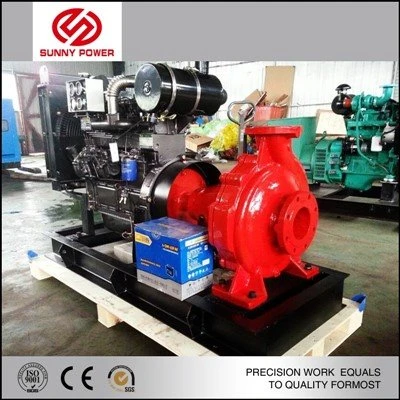
Diesel engine fire pump tank installation matters:
1. It is recommended that users install an oil-water separator on the oil supply pipeline.
2. When connecting the pipelines of the fuel tank, it is strictly forbidden to use ordinary raw materials to seal them to prevent them from entering the diesel engine fire pump due to dissolution and causing pipeline blockage.
3. The fuel tank of the diesel engine fire pump should be installed away from heat sources and vibrations, because vibrations will cause sediment to appear, and heating will cause power to decrease.
4. Considering fire protection requirements, it is recommended that fuel tanks above 1000L be placed separately and isolated from the diesel engine fire pump set.
5. Fuel temperature is an important factor related to the good operation of the diesel engine fire pump. Oil temperatures higher than 60°C will cause volume expansion, significantly reducing the heat capacity per unit volume of the fuel and reducing the output power of the diesel engine fire pump. Therefore, when using a diesel fire pump, the influence of external heat sources on the oil temperature should be avoided.
6. It is recommended that the user install the oil tank so that the oil suction head does not exceed 2 meters, and the oil suction head of the output pump should be calculated from the bottom of the oil tank.
7. The fuel tank should avoid exposure to the sun. The fuel tank should be placed away from fire sources. No smoking, sparks or flames are allowed near the fuel tank. Volatile fuel may cause an explosion. There should be corresponding fire-fighting facilities (such as foam fire extinguishers, sand, etc.) near the fuel tank. It is strictly forbidden to use water as fire-fighting material. It is recommended that the placement of fuel tanks larger than 2000L should be approved by the fire department.


