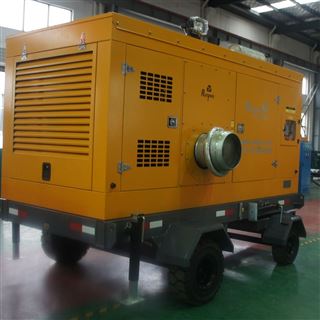
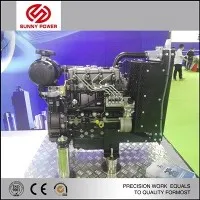
Flood control and drainage pumps are mainly used to remove blockages or excessive waterlogging in municipal rainwater pipes and equipment, neighborhood or factory rainwater pipes, and urban road rainwater pipe systems.
Then let me share with you how to install a flood control drainage pump.
1. When transmitting, attention should be paid to the coaxiality of the pump shaft and the output of the motor or diesel engine; the accuracy of the pump installation has a great impact on the smooth operation and service life of the pump, so it must be installed and corrected carefully.
2. The coupling of the flood control drainage pump must be firmly secured with a nut, and the nut must be locked tightly to prevent the nut from loosening, otherwise it will easily cause the impeller to move and cause mechanical failure.
3. In order to maintain a certain amount of storage liquid in the pump body, achieve better self-priming ability and prevent dry friction of the mechanical seal, the pump inlet must be higher than the center line of the pump shaft.
4. When installing the suction pipeline, attention should be paid to:
A. The installation height of the suction inlet should not exceed 5 meters. When conditions permit, the installation height of the suction inlet should be as low as possible below the low water storage level of the pool. The length of the suction pipe should be shortened as much as possible and fewer elbows should be installed. This will help shorten the installation time. Self-priming time, improve self-priming function.
B. Valves, flanges, etc. in the suction pipeline should strictly prevent air leakage or liquid leakage, that is, no air leakage is allowed in the suction pipeline.
C. The pump body should be prevented from inhaling solids and other debris. For this reason, a filter should be installed on the suction pipeline. The effective water passing area of the filter should be 2-3 times the cross-section of the suction pipe, and the filter should be inspected regularly.
D. The suction pipeline and discharge pipeline should have their own brackets, and the pump body itself is not allowed to bear the load of the pipeline.
5. When installing the pump, the electrostatic grounding resistance of the pump and pipelines should meet the specified requirements.
6. During installation, you should strictly check whether there are stones, iron sand and other debris in the pump casing and pipelines.
7. Correct the installation clearance and coaxiality of the pump coupling and motor coupling. The allowable deviation of the non-axiality is 0.1mm. The height difference between the pump shaft and the motor shaft can be adjusted by placing copper or iron sheets on the feet.
8. After the unit has actually been running for 3-4 hours, make an inspection. If there are no bad phenomena, it means that the installation has been completed. The shaft should be checked during the trial operation.
9. The cooling water joint of the bearing body of the flood control and drainage pump equipped with a cooling chamber device is used for a rubber hose or plastic pipe with an inner hole of 12, and its thread size is M12x1.75.
10. If a one-way valve is installed on the outlet pipeline of the flood control and drainage pump and the pump cannot discharge gas smoothly during the self-priming process, an exhaust pipe and valve should be added to the outlet of the pump.