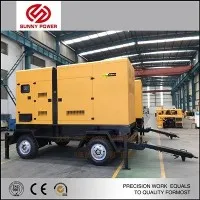
Diesel engine fire pump sets are generally used to transport fire water or foam fire extinguishing agents. When a fire occurs, if the power supply fails and the electric fire pump set cannot be put into use normally, the diesel engine fire pump set can automatically start to operate to ensure the normal fire fighting, saving the mains power supply transformer and normal expenses, and is also suitable for various emergency standby pump occasions.
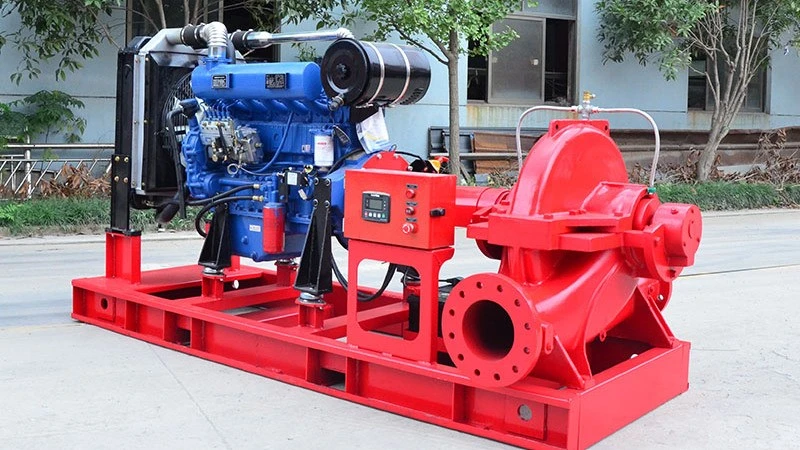
The diesel engine fire pump is composed of diesel engine, fire pump, coupling, base, water tank, fuel tank and other parts. The fire pump set can use single-stage single-suction pump, multi-stage single-suction pump, single-stage double-suction pump, self-priming pump, long-axis pump and other pump types, or a combination of multiple pump types in parallel, with a wide range of flow and pressure.
The characteristics and application scope of common diesel engine fire pump sets are introduced as follows:
1. Diesel engine single-stage double-suction fire pump (split center pump): uniform flow rate, stable operation, large flow, good suction performance, strong anti-cavitation ability, simple structure and low cost. There are two suction ports on the impeller of a single-stage double-suction pump, which has a great advantage in balancing the axial force. The split-center structure is easy to maintain and is suitable for small and medium-sized buildings or relatively simple high-flow, low-pressure differential fire protection systems.
2. Diesel engine multi-stage single-suction fire pump: The head is higher at the same flow rate, the flow rate is stable, and it can provide stable water supply and pressure. The structure is relatively complex and the manufacturing and maintenance costs are high. The multi-stage single-suction fire pump is composed of multiple impeller stages in series, which can generate higher pressure and is suitable for fire protection systems that require long-distance water transportation or water supply to high-rise buildings.
3. Diesel engine single-stage single-suction fire pump (end suction pump): The medium that can be transported has high viscosity, simple structure, low cost, convenient maintenance, and the applicable head is higher than that of the double-suction pump.
4. Diesel engine deep well fire pump (vertical long-axis fire pump): compact structure, small footprint, long-axis design to increase flow and head, suitable for fire protection systems with limited space, and the use of extracting fire water from deep wells, hot springs, rivers, lakes, and seas.
5. Diesel engine fire mixed flow pump: large flow, high pressure, high delivery efficiency, low energy consumption; simple structure, easy maintenance, long service life; large flow area, not easy to clog, and stronger anti-cavitation ability than axial flow pump. The disadvantages are high noise and poor adjustability. It is suitable for fire protection systems with many media, large flow and low head.
6. Diesel engine fire self-priming pump (rotor pump): It has strong self-priming ability, wide medium viscosity delivery range, strong impurity passing ability, low speed, high head, high efficiency, constant flow and strong head self-adaptation ability. It is suitable for non-self-priming low-level water tanks and fire protection applications that draw water from rivers, lakes and seas.
The above is an introduction to the characteristics and application scope of several common diesel engine fire pump groups. When selecting the actual model, it is necessary to comprehensively consider the height of the building and the building specifications, the flow and pressure requirements of the fire pump, the water supply situation and the performance parameters of the specific fire pump, etc.