The basic structure of a diesel generator is composed of a diesel engine and a generator. The diesel engine drives the generator to generate electricity.
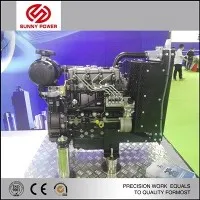
The basic structure of a diesel engine: consists of cylinders, piston, cylinder head, intake valves, exhaust valves, piston pins, connecting rods, crankshaft, bearings and flywheels. The diesel engine of a diesel generator is generally a single-cylinder or multi-cylinder four-stroke diesel engine. Below I will only talk about the basic working principle of a single-cylinder four-stroke diesel engine: the starting of a diesel engine is to turn the crankshaft of the diesel engine through manpower or other power to make the piston seal at the top of the cylinder. Make up and down reciprocating motion. The piston completes four strokes in motion: intake stroke, compression stroke, combustion and power (expansion) stroke, and exhaust stroke. When the piston moves from up to down, the intake valve opens, and the fresh air filtered by the air filter enters the cylinder to complete the intake stroke. The piston moves upward, the intake and exhaust valves are closed, the air is compressed, the temperature and pressure increase, and the compression process is completed. When the piston is about to reach its highest point, the fuel injector sprays the filtered fuel into the combustion chamber in the form of mist, mixes it with the high-temperature and high-pressure air, and immediately ignites and burns on its own. The high pressure formed pushes the piston downward to do work, pushing the crankshaft to rotate, completing the action. power stroke. After the power stroke is completed, the piston moves from bottom to top, the exhaust valve opens to exhaust, and the exhaust stroke is completed. The crankshaft rotates half a turn for each stroke. After several working cycles, the diesel engine gradually accelerates to work under the inertia of the flywheel.
The rotation of the crankshaft of the diesel engine drives the generator to generate electricity. The generator includes a DC generator and an AC generator.
DC generator is mainly composed of generator shell, magnetic pole core, magnetic field coil, armature and carbon brushes. Working principle of power generation: When the diesel engine drives the armature of the generator to rotate, due to the residual magnetism in the magnetic pole core of the generator, the armature coil cuts the magnetic lines of force in the magnetic field. According to the principle of electromagnetic induction, the magnetic induction generates current and outputs the current through the carbon brush. .
The alternator is mainly composed of a plurality of permanent magnets (called a rotor) made of magnetic materials with alternating north and south poles and an armature coil (called a stator) made of silicon cast iron and wound with multiple sets of series coils. Working principle of power generation: The rotor is driven by the diesel engine to axially cut the magnetic lines of force. The alternately arranged magnetic poles in the stator form an alternating magnetic field in the coil core. When the rotor rotates once, the direction and size of the magnetic flux change many times. Due to the transformation of the magnetic field, An induced current varying in magnitude and direction will be generated in the coil and delivered by the stator coil.
In order to protect electrical equipment and maintain its normal operation, the current generated by the generator also needs to be adjusted and controlled by a regulator, etc.
Basic Structure Of Diesel Generator
Jan 12, 2024



Send Inquiry
Latest News